

A huge question i’ve been asked over and over the last few years is can TikTok work for B2B brands and that was the subject of our most recent report into the 10 best B2B brands on TikTok at the moment.
One of the stand outs from that list is a brand you might not immediately be familiar with - tl;dv. They’re an AI powered meeting recorder that automatically records, transcribes, and summarises meetings… oh and they do cracking good social media as well.
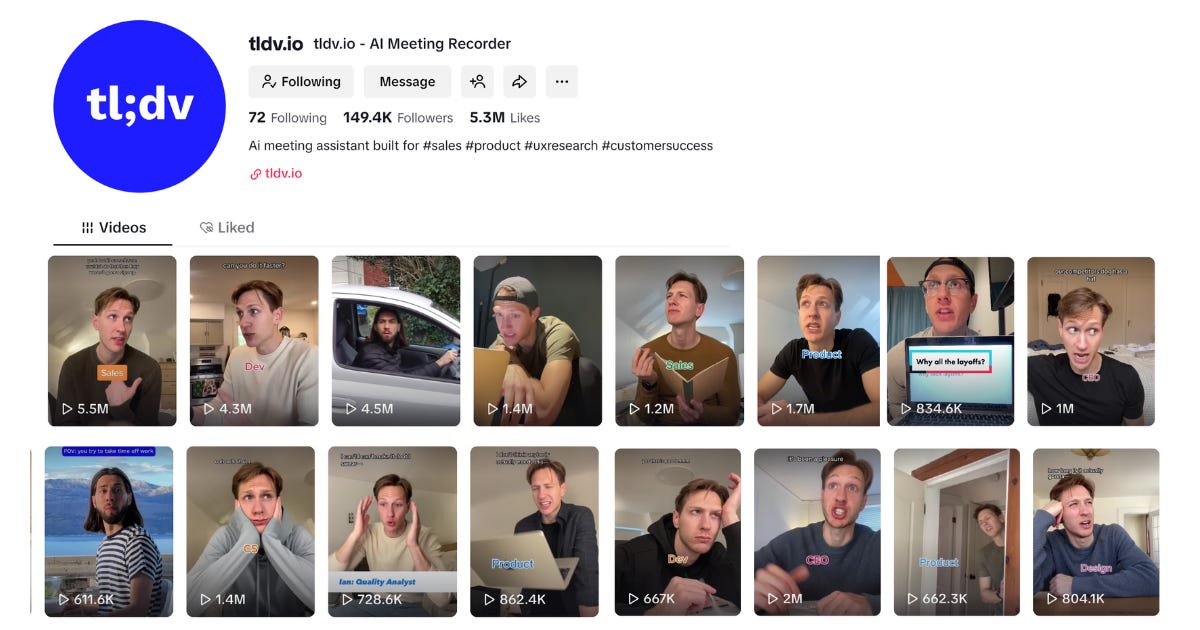
Their TikToks may have ended up on your FYP at one point, and they’re brought to life through 3 brilliant creators, including Ian Evans.
I caught up with him to chat all things TikTok and how they’ve made it work all whilst working remotely.
Sam: Hey Ian, can you break down what your role is at tl;dv?
Ian: I'm one of our social media video producers. Honestly, we've never given ourselves formal titles, so I do tend to change it a lot on LinkedIn for fun. Not to CEO though. There's three of us: myself, Tom, and Renee on the English pages, and we have another creator, Pedro, on the Brazilian page. I've been there for about three years now.
Sam: And you feature in the brand’s TikTok a lot. Is it all from your side? Is there a strategy above that?
Ian: We’re quite small. You can think of our structure like three individual TikTokers who all post to the same account, but most videos are created independently.
We’ll meet about once or twice a week. I’ll throw all my ideas at Tom and Renee, they throw them all back at us. Once you’ve pitched an idea to get a bit of feedback, it’s really on that creator to get it out the door. If I can’t make something with my phone in my own house, I can’t really make it.
Sam: And this is all done remotely in different countries?
Ian: Yeah, completely. Tom is in the UK, I’m in Vancouver, and Renee is in Perth. So the three of us never have a call all together at the same time. But 24/7 someone is awake, so comments get responded to.
I think it helps because we’re all pretty strong content creators in our own right. I ran my own pages for fun before tl;dv found me. If you can make something with your phone, you’re good to go. Some big companies want to be in an office or they want it to be official, and you’re going to have to turn that down a little bit if you want to do this remotely.
Sam: How did this all begin?
Ian: About 3 years ago, Raphael Allstadt, our CEO, decided he wanted corporate content. He was like, “I want a TikTok page. I want it to be funny work from home jokes.”
So he just went through the corporate 2020 work from home niche and DM’d all the creators he found. Rapha worked with Tom in April on a launch video for ProductHunt and then hired him to do socials and then 3 (ish ) months later, they found me. I had just gotten laid off that same week, so it was well timed.
He basically just gave us the directive: “If you would make it for your own page, make it for ours.” It wasn’t to push the product. He was like, “Just be funny for corporate people.” That was it.
Sam: Had tl;dv done anything on TikTok before this?
Ian: No, first entry point. That’s the thing, people go to their marketing team and say, “Hey, make me a TikTok.” But none of their marketers are content creators.
Just because you can make a good ad campaign it doesn’t mean you know how to be in front of a camera. Tom and I aren’t really marketers, but we’re good in front of a camera.
And then everyone said, “Wow, you’re great at marketing.” And we were like, “I guess we are!”
Sam: What was the goal when you launched? Was it brand awareness? Lead generation?
Ian: The first objective was obviously brand awareness, but it was also just to prove that we can get the ball rolling. It really was to ‘go viral’. And then obviously with the intention of leads and signups down the road.
Sam: Why even come onto TikTok in the first place?
Ian: Everyone’s there. It’s just a giant channel funnel waiting for you. If you can talk TikTok, it’s yours.
Sam: What was the video or moment where you were like, “Okay, this is working”?
Ian: I wish it worked immediately.
When we first started, we just did trending audios. Didn’t have to speak, didn’t have to be creative. It was great. After about 2 months, nothing was really working. So our Rapha asked for us to stop doing trending audios and try and be more original.
So I scripted out a really basic interaction between two employees describing how a one on one works. It was a little on the nose.
And it got maybe 300,000 views.
At the time, that was insane. We were like, “Oh, this is going to work. We have to use real jokes, be really original if we want to win.”
Then it was like another three months until we stumbled across the skit format with the characters.
Once we had the characters and people started commenting what they wanted to see and then I started making videos and then they commented again, it was like a little snowball. That’s when after 6 months the ball was truly rolling and we were gaining 10k+ followers monthly.
Sam: How many videos roughly until you got there?
Ian: It’s 102. I have checked.
Sam: It really takes far longer than people expect to crack it doesn’t it!.
Ian: There’s also like you participate on social media, you do what you should do, and then there’s when you figure out what you want to do and it’s finally different.
Sam: If you were going to describe the strategy what would that be?
Ian: I think we get on and we’re like, “Hi, we’re a brand. Please use our software. Thank you so much.” Other people get on and they’re like, “Oh my gosh, I love this product.”
And we’re all like, “Shut up. That’s an ad.” The total complete openness of just like, “This is why I’m here. This is why I’m doing this. Don’t forget to buy our software.” That’s always the energy behind every post, no matter what we’re actually saying.
Sam: How do you blend education and entertainment?
Ian: If we ever do a breakdown video or a “what is” video, it’s usually because we’ve seen comments saying “hey we actually don’t understand this.”
Sometimes Rapha will give us a topic he wants discussed. So he’s like, “Oh we want to create around AI right now.”
I’ll make a joke and then everyone in the comments is like, “Yeah I didn’t get that. That was so niche.” So then I go back and do a “what is an AI agent” video and you bounce around between have fun, explain it, if they’re confused go back, explain it again, go have more fun now that they understand it.
Sam: That’s the inherent danger of talking about niche things. You have an expected understanding the audience might have.
Ian: Completely. I see some who make very niche jokes and I’m like that’s awesome, you should get very specific. But then it’s too niche and no one understands it and they don’t want to take the time to explain it.
If you explained it, the people who understood it would watch it and go “nice, that’s right.” And the people who didn’t would watch it and then stay.
Sam: What is the core audience you’re trying to reach on TikTok? Has that evolved?
Ian: We’re a very general tool. Everyone has meetings, everyone needs to take notes. So as long as you work at a company somewhere with a meeting, you’re a customer, which is very lucky.
At the start though, we were targeting mainly product managers and sales reps because they have meetings with tons of important information you need remembered.
As the skits evolved, the audience got bigger because people wanted to see QA included, they wanted to see HR.
They aren’t really our ICP, but as long as I could make a skit that included our ICP, I didn’t mind extending the family.
Sam: A really common question I hear from B2B companies is “are my audience even on TikTok?” What would you say to that?
Ian: Everyone’s on TikTok. I think if you’re very metrics driven, social is a really frustrating funnel because it’s slow. It’s really hard to prove.
Even after 3 years and everyone says we’re doing a good job, I can’t point to any numbers specifically and say, “Yeah, I drove that.”
We have a signup link that asks “How did you hear about us?” and we do see spikes similar to when we’re driving a lot of views. But it’s because our boss has always believed in us and we never have to prove it.
If you are doubtful about it, that’s so hard. It’s a risk and it’s going to feel uncomfortable.
But if everyone is already on this platform, then your audience is there. You just have to figure out how to get in front of them.
You have to figure out what energy you’re going to tap into them at. We’re very crass. We like to create around the things that suck about the jobs. We make a lot of very blunt statements like, “Oh, my boss is an idiot.”
TikTok has always felt like that safe space to be yourself.
You want to jump on TikTok and you want to be validated that you hate your developer today. But on LinkedIn, those videos don’t do as well because obviously you can’t show that frustration publicly to your boss, but you can on TikTok.
Sam: How are you planning out content? Do you have a formal calendar?
Ian: It’s a little more spontaneous than people think. We all know roughly what days we post. At the moment, I’m aiming for Monday, Wednesday, Friday. Tom’s aiming for Tuesday, Thursday. Renee has her days.
As long as you have something up on the day you said you would or you’ve just said, “Hey, I’m not going to post today,” that’s kind of as far ahead as we plan. If there’s ever a big trend coming, that’s about as far ahead as I’m really thinking. We all think maybe one day to a week ahead max.
Sam: That’s traditional social media marketing. Everyone has this grand ambition to have a really planned calendar, but it’s quite often fighting against the week in front of you.
Ian: Yeah, completely.
Sam: Your formats feel pretty consistent. What are the ones that work best?
Ian: We all have a different energy, a different style. The ones that have always worked for me are the skits. I can get two people to just fight and people seem to enjoy that.
Tom's format, he's truly a filmmaker because he can make really artistic videos, really high quality looking spoofs. He does quite well putting our characters in movies and then spoofing that or that parody style.
Renee runs LinkedIn. She is really good at that self awareness on the platform where she’s speaking to what you’re feeling after scrolling for an hour.
Sam: How do you use data to inform what you post next?
Ian: Simply put, if your video gets a million views, figure out what worked, make it again. That’s the simplest data we’re always using. I like looking at the number of likes. I truly find if a video is breaking 10% like engagement rate, people really liked that. That was a good joke. And I know when I mail it in some days and it’s like three or four percent.
Even if it didn’t perform really well, if it got 10% I’m like it was a good video.
Sam: How do comments inform what you do?
Ian: Comments are really the only thing I really care about truly. People are so brutally honest. “Hey, that was incorrect, you’re an idiot.” I’m like, “Oh, okay. I won’t do that again.” Or they’ll say, “Hey, this was awesome. In reality, it’s actually like this.”
More than half of my videos just come straight from a comment where somebody says something about their experience.
I’m like, great, if that’s their experience and that’s probably everyone’s, I’m just going to use that.
The comments are really just the feedback box.
Sam: What role do trends have in your business?
Ian: I love trends. I’ll always enjoy a trend, but I really don’t think you can rely on them. A trend is kind of like a lucky snowball. It lands in your lap. You use it or not.
You kind of need to have your own story, your own story line running if you’re going to make any long term success. A trend is like if it fits with my story line at the time, I’m going to use it. If not, let it go. So I would say maybe 10% of what we do are trends but the 90% is our own thing.
Sam: There’s such nuance to trends. It’s hard to be remembered by a trend.
Ian: The other thing is the rules for trends are different depending on your company
A big brand can use a trend in a way I can’t. And I think especially in the B2B space, I like thinking of it this way. No offense, but nobody knows who you are and nobody cares. You know, like you’re a software ew, you’re the last company I want to see.
But if Delta Airlines did a post when Taylor Swift dropped her last album and everyone was in orange, that’s cute.
That’s a company with brand awareness. If they make themselves fun and present, I go, “Nice, they participated.” If I paint TL;DV’s logo in orange feathers, nobody knows who we are.
That’s a waste of everyone’s time. It just makes trends harder and doesn’t do anything for you. If I’m going to pick a trend, it’s a trend where I can get our story in, I can also explain who we are. Otherwise, I’m not touching it.
Sam: That’s such a good quote. Half the time I’m like, “Guys, you shouldn’t be going anywhere near this. No one cares who you are.”
Ian: That’s how I feel when a legacy brand starts a TikTok, posts one horizontal video of an ad and they have 400,000 followers and I’m like, well, you’re just Toyota. I can’t beat you.
Sam: Who comes up with the ideas and what does the team look like?
Ian: It’s four creators: three on our English page, one on our international Brazilian page, and then Rapha, our CEO. Really that’s the team.
Basically one Slack channel where we all fire off any posts we saw that we liked. We send them to each other. If I see something, I’m like, “Oh, that’s a Tom idea. Have it.”
Anything we like, we decide we take. And then it’s up to that person to ship it, make it, film, produce, post. If they don’t like it, the idea disappears.
Sam: What does the internal process look like for sign off? Do you have push back?
Ian: We have a very minimal process. I think that’s where a lot of brands get lost. There’s no process, there’s no approval, there’s no pitching for ideas that are regular. If I’m making a skit with our characters, if I’m making a format that we know works, it’s already brand safe. I’m not going to get us canceled. I’m going to make a lame joke at most.
So that kind of stuff doesn’t have an approval process. A regular video shouldn’t have any approval and then the weird ones should. In that case it’s really just a word doc. We all add our comments and then when we feel it’s ready we post it.
Sam: Have you ever had a video that hasn’t been approved?
Ian: Yeah. I think that’s what made it work really well is that it’s easier to post something and then my boss sees it and goes, “Okay, that’s not right. Let’s do something else next time.” I made one video early on about Taylor Swift’s ticket disaster and I tried to make it like a fun conversation.
My boss was like, “That’s fine, but I don’t really think that’s going to get the audience we want.” So I was like, “Okay, very clear. I shouldn’t have made that, but it didn’t end the world, so I just didn’t make it again.”
Sam: Have you seen tangible business impact from TikTok?
Ian: We always collect the comments that come in that are like, “Hey, I actually use your software. It works.” Or, “I’m obsessed with this.” Those are the things that are concrete proof that I’ll always take. I think way back like two years ago when we were really chugging along, a third of our signups were coming from social and that was the peak.
The other thing too is we have about 25 to 30 employees and our three co founders include the CEO who’s also one of our head sales people. If one of the co founders is taking all the sales calls and they keep hearing positive things about social media when people sign up, I don’t need to prove it. There’s that just infinite feedback. A lot of prospects in sales calls were like, “Whoa, I love your social media.” And he’s like, “Great, done.”
Sam: So there’s a lot of anecdotal feedback that’s probably really difficult to measure otherwise.
Ian: Yeah. And then on LinkedIn too, you just see a lot of positive comments. Very anecdotal, but it’s very present.
Sam: What advice would you give to B2B brands thinking about TikTok?
Ian: Work with content creators rather than trying to train your marketing team to become content creators. Find people who are already good in front of a camera. The other thing is don’t be afraid to let them run with it. Rapha gave us the directive: “If you would make it for your own page, make it for ours.” That freedom is crucial.
Also, accept that social is a slow funnel. It’s really hard to prove with metrics. You need leadership that believes in it even when you can’t point to specific numbers. It’s a risk and it’s going to feel uncomfortable, but if everyone is already on the platform, your audience is there. You just have to figure out how to get in front of them.
Sam: There’s a lot of talk about EGC in the industry at the moment and because you’re essentially employees of a company. What advice would you give companies here?
Ian: I know people are nervous to have employees become faces because what if the employee leaves? But I think if you’re a good company and you’re flexible with how the role evolves, no one’s going to be actively running for the door.
When I first started, I was just doing five videos a week. I’d send them off to a Dropbox and I never met anyone. Then after 3 months, when videos started to work, Rapha was like, “Do you want to join the team? Do you want to join the Slack channel?” The partnership kept evolving as we proved it was working. That flexibility is key.
Sam: What advice would you give an employee who’s asked to be in content and potentially a content creator who’s thinking of working for a brand?
Ian: Being the face of a brand is awesome. It’s incredible exposure. It’s going to just give you opportunities.
If you are a content creator for yourself, it’s a losing battle every day between making my own content and the company’s content.
Transparently, I have not made content for myself since March. One of them’s going to win. It’s the one that’s paying you. So think about that when you decide. But it is great for your career.
The other thing, if you are asked to make content at work, keep in mind that we have three full-time people making content. If it’s a part of your job on the side, it’s an impossible ask. It is a full-time job you’ve been asked to do.
You can’t always say, “Hey, no, pay me more.” But if you are going to take that on, it should lead to some significant growth, I think.
Sam: Any other brands you’re watching right now?
Ian: Obviously Morning Brew, of course. One I really like is The Attention Seeker, a New Zealand marketing agency. Jony Lee just spits out content and tells the company’s story so well and is just such a fun person.
hey I know them 🫡